With central banks buying at nearly twice the expected pace, what does this mean for the price of gold?
02. 06. 2026Bc. Miroslava Sojková, Social Media Director
Central banks are buying almost twice as much gold as expected. Find out what this means for gold prices, investment decisions, and the market outlook.
Central banks are buying gold at a record pace. What does this mean for the price of gold?
Until recently, it would have seemed almost unbelievable that central banks would be buying gold in the volumes we are seeing today. Yet that is exactly what is happening, and this trend is becoming one of the clearest signals on the global gold market.
Goldman Sachs analysts say expectations have shifted sharply. Where central banks were previously expected to buy around 29 tonnes a month, current figures now suggest a figure closer to 50 tonnes. The outlook for 2026 goes even further, with central banks potentially buying as much as 60 tonnes of gold a month. In other words, demand from these institutions is now almost twice as high as originally expected, even with the gold price still at record highs.
As our Sales Director Mgr. Ing. Filip Horáček, Ph.D. puts it, “All the figures that once seemed completely unimaginable are now becoming reality.”
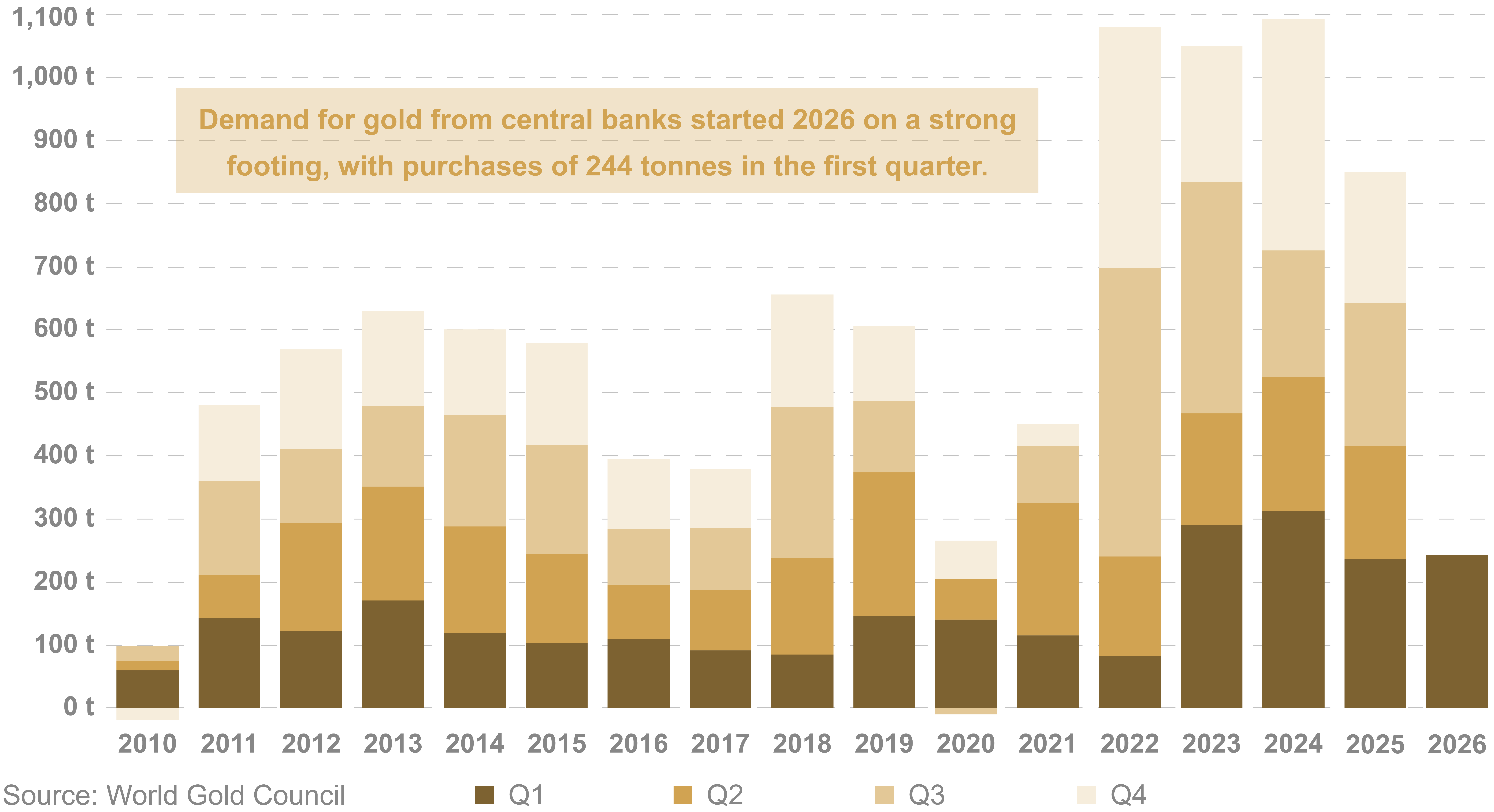
World Gold Council data tells the same story. Central banks bought 244 tonnes of gold in the first quarter of 2026, up 17% quarter on quarter. This continues a long-term trend in which gold is once again becoming a key part of countries’ reserve strategies.
Gold purchases by central banks
Why central banks are buying gold
It is important to understand that these purchases are not speculative. Central banks are not buying gold to profit from short-term price movements, but as a strategic decision designed to protect their reserves in an uncertain global environment.
The main reasons include rising geopolitical tensions, trade conflicts between major powers, high inflation, growing government debt, and the gradual diversification of reserves away from the US dollar. In this context, gold is returning to its traditional role as a stable and trusted reserve asset.
Central bank gold reserves

How central banks’ demand affects the price of gold
Long-term, steady buying by central banks gives the gold market strong support. When the world’s largest institutional players keep adding to their holdings, they naturally reinforce demand and keep prices stable.
Most active gold buyers

This helps to explain why, despite the sharp rise seen in recent years, gold remains close to record highs and has not experienced deeper corrections. The market is underpinned by strong, consistent buying.
What analysts expect for the gold price
Goldman Sachs is also upbeat on gold, forecasting that the price could reach around USD 5,400 per ounce by the end of 2026. This suggests that institutional capital still sees room for further growth.
Gold as a safe haven in an uncertain world
Gold today is not driven by short-term market sentiment alone, but also, and more importantly, by long-term global factors. These include geopolitical uncertainty, countries seeking greater financial independence, and the growing need to protect value from inflation and debt.
As a result, figures that once seemed unimaginable in the economy often become reality. Gold has long served as a safe haven for investors looking to protect their wealth in uncertain times.
Current developments show that gold is no longer just a commodity, but a strategic asset being systematically built up by central banks themselves. Against this unsettled backdrop, its role in the global financial system continues to strengthen, and demand from central banks suggests that this trend may continue in the years ahead.
For individual investors, it may therefore be worth following this long-term trend and considering how gold could fit into their own investment strategy.
More information about ways to invest in gold can be found here.